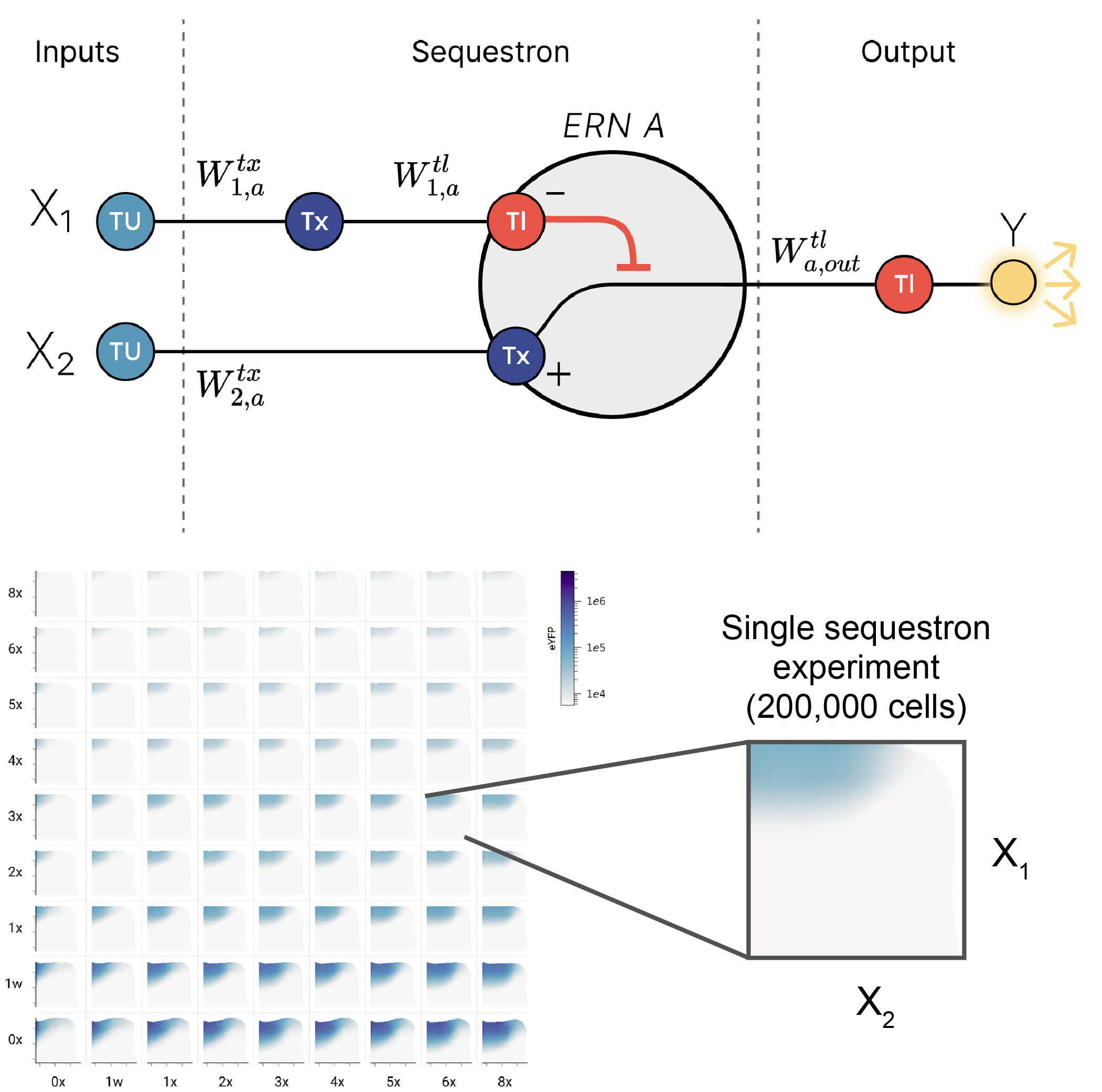
Living cells can be programmed to encode and execute neuromorphic primitives and networks. This concept emerged from simulations of “neuronal” toggle-switch architectures with staged mutual inhibition and experimentally characterized switching dynamics (Mapar 2018; Mapar 2019), revealing how genetic regulation can mimic neural behavior. Subsequent work demonstrated that genetic circuits within single cells can function as biomolecular neural networks, performing neural-like computation through gene regulation and molecular sequestration (Moorman 2019). Experimental realizations in bacteria established synthetic neuromorphic computing that performs analog computations using interconnected genetic devices (Rizik 2022). Building on these foundations, optimization frameworks based on Signal Temporal Logic enabled systematic design of circuits capable of regression and feedback control (Palanques 2025). Most recently, a library of over 400 multi-node neuromorphic circuits in mammalian cells has been constructed, exhibiting finely tuned analog classification behaviors (unpublished). Together, these efforts chart a path toward increasingly sophisticated neuromorphic genetic systems—multi-input classifiers, adaptive feedback controllers, and ultimately cellular processors that can learn and act within living tissues, transforming how biological computation is designed and applied in synthetic biology and therapeutic contexts.
Neuromorphic Bio-computing
Living cells can be engineered to perform neuromorphic computation using genetic circuits that emulate neural dynamics through regulation and molecular interactions. Our work combines simulation, experimental validation, and formal optimization to create scalable biomolecular neural networks capable of analog computation, feedback control, and self-adaptive learning.