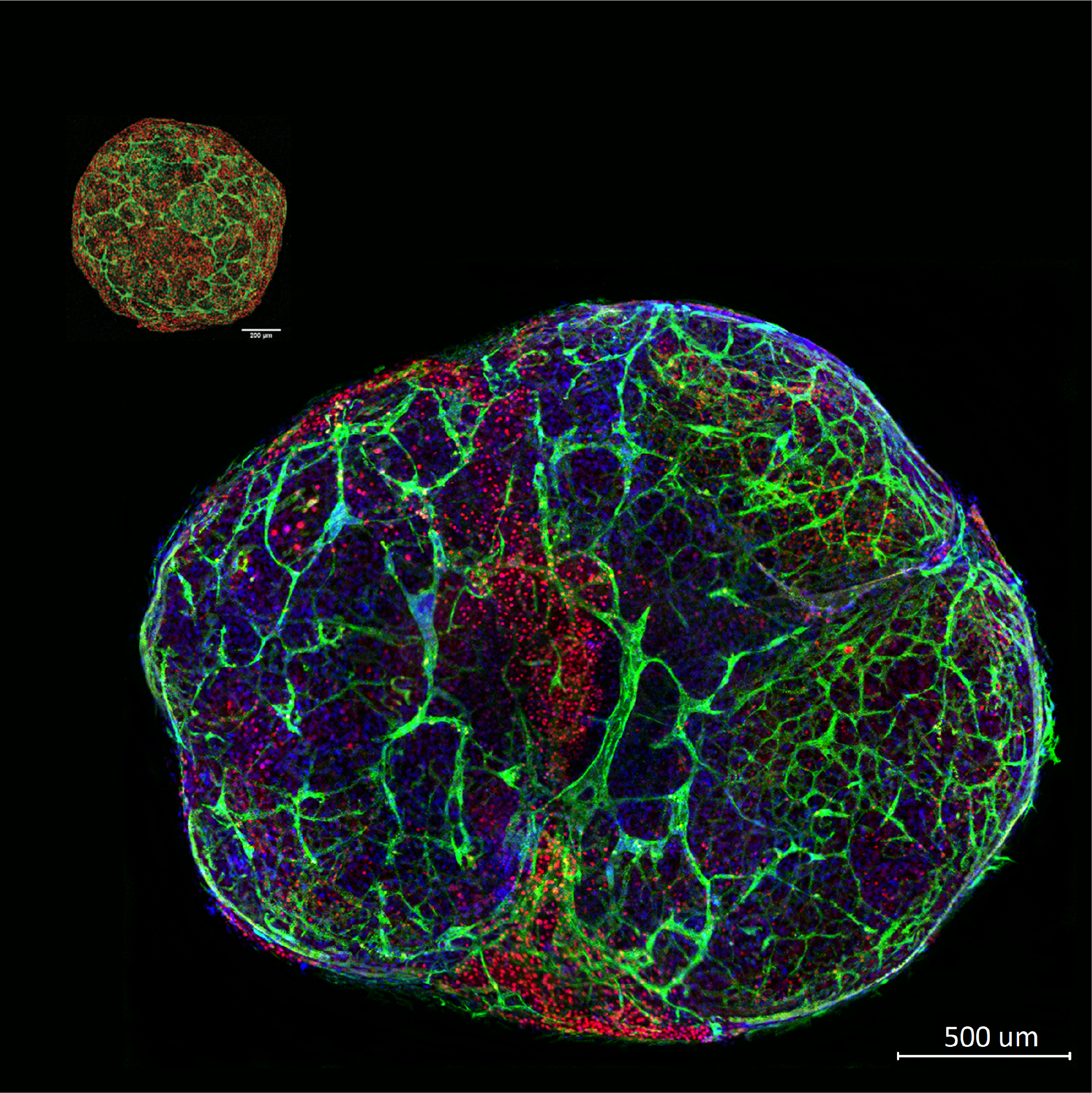
We approach morphogenesis as an executable program, creating genetic circuits that precisely control cell fate and programmed differentiation, guiding cells to self-organize into desired three-dimensional structures. Conceptually, synthetic morphogenesis is achieved through designer gene networks that impose developmental rules on human cells, linking lineage specification to spatial organization (Teague 2016). We have demonstrated fate control at two ends of the spectrum: rapid, transcription factor–driven neurogenesis from human stem cells (Busskamp 2014) and GATA6-programmed hepatic differentiation that directs human induced pluripotent stem cells to self-organize into large-scale (millimeter- to centimeter-sized) vascularized liver organoids formed through the co-development of all cell types present in liver buds (Guye 2016). We introduced design rules for shaping tissues, including an integrated computational and experimental platform for programming three-dimensional shape formation based on cell–cell adhesion (Tordoff 2018) and mechanistic principles for incomplete cell sorting as an engineerable route to long-term stable multicellular architectures (Tordoff 2021). We established genetic circuit–based synthetic symmetry breaking using recombinase-based toggle switches that pattern cell–cell interactions and yield programmable three-dimensional multicellular structures, integrating fate control with spatial rules in mammalian systems (Wauford 2023). Using genetically encoded endoribonuclease-mediated microRNA sensors, we chromosomally integrated genetic circuits capable of reading endogenous cell states and actively steering cell fates toward desired outcomes through automated multistep differentiation from hiPSCs to hematopoietic stem cells, thereby converting continuous cell-state monitoring into actionable control that dynamically programs lineage choice (Wang 2024). I helped define and organize the Multicellular Engineered Living Systems (MCELS) field (Kamm 2018), articulating what constitutes an MCEL, why it matters, and outlining a roadmap from near-term demonstrations to translational impact. I also led the development of a practical playbook (Aydin 2022) that distilled design primitives (cell types, signaling molecules, matrices), control architectures (open- and closed-loop systems, cell–cell and cell–material interfaces), and evaluation criteria (robustness, reproducibility, manufacturability), turning the 2018 vision into a structured methodology that other groups could adopt. Together, advances from my lab provide a rigorous, end-to-end strategy—from transcriptional programs that drive lineage specification to experimental and computational platforms that control where and when those fates emerge—for building organoids that execute user-defined morphogenesis for disease modeling and regenerative medicine.
Programmable organoids and synthetic morphogenesis
We engineer morphogenesis as an executable genetic program, designing circuits that direct cell fate, differentiation, and self-organization into defined 3D structures. Through synthetic gene networks linking lineage specification to spatial patterning, our work has established design rules, computational frameworks, and genetic control systems that guide multicellular organization—from stem cell–derived tissues to programmable organoids for disease modeling and regenerative medicine.